

Ask three South African web designers to quote on “a five-page business website” and you could easily get three numbers that differ by a factor of ten. It’s tempting to assume the cheapest is efficient and the most expensive is greedy. Usually neither is true. They’re quoting on different websites that happen to share a page count.
That’s the real problem with website pricing in South Africa. Advertised prices are easy to find. Knowing what a given price actually buys, what it leaves out, and what you’ll still be paying for two years later is much harder. This guide focuses on that second problem: how to read a quote, how to compare two of them fairly, and how to work out the total cost of a website rather than just the launch invoice.
What does a website actually cost in South Africa?

A September 2026 review by South African agency Orcanically examined publicly advertised website prices from 50 businesses. It reports these median listed prices by package type (Orcanically’s 2026 survey):
Advertised package category | Survey’s reported median |
|---|---|
Entry-level website, once-off | R3,225 |
Business website, once-off | R6,250 |
Online store, once-off | R7,250 |
Entry-level monthly website plan | R299/month |
Read these as a snapshot of advertised packages, not a national average of completed website projects. The sample covers suppliers with public prices; package inclusions differ, categories have different sample sizes, and VAT treatment is not standardised across the advertisements. The monthly category includes only six packages. It would be misleading to assume that a R7,250 store and a complex ecommerce project offer the same deliverables.
For another point of reference, Orcanically’s own published packages start at R5,000 for a small website, R12,000 for its business package and R25,000 for ecommerce. These are one supplier’s offers, not national averages. The difference between them and the survey medians illustrates why scope matters more than price alone.
It also helps to separate two things that both get called “the price”:
An advertised package price describes a defined scope. It tells you what the supplier is willing to deliver for that amount if your needs fit inside the package.
A project estimate is a price for your scope. It should be written after someone has asked what the site needs to do.
A package can be a perfectly good buy. It becomes a bad one when your requirements quietly exceed it and the extras arrive later as change requests. For a separate comparison of advertised packages, see Magoven’s 2026 South African website and SEO package comparison.
What actually changes the price of a website
Design: template, adapted theme or custom
One important cost lever is how much of the design must be developed specifically for you. A template site uses an existing layout and swaps in your logo, colours and text. An adapted theme starts from a pre-built design but reworks sections, page structures and components. A custom design starts with your customers and your offer, and the layout is built around them.
None of these is automatically right. A plumber in Polokwane who mostly gets work by phone may get excellent value from a well-chosen template. A firm competing on credibility for large contracts, or one with an unusual service that needs explaining, often needs the thinking that comes with custom design. The question to ask is whether the quote includes any design decisions, or only design application.

Content: the line item most quotes leave out
Many low quotes assume you’ll supply all the text and images, ready to use, on time. Content can delay a project when the quote assumes the client will supply finished material but nobody has agreed a delivery schedule. Ask who is writing the copy, who is sourcing photography, and who is moving content over from an existing site. If the answer is “you”, budget your own time or a copywriter’s fee. A quote that includes professional copy and one that doesn’t are not comparable, even if the designs look alike.
Functionality: CMS, ecommerce, bookings and integrations
Features that process data, transactions or customer actions can add cost, particularly where testing and integrations are required. Typical examples:
A content management system you can edit yourself, plus training on how to use it
Online payments through a South African gateway
Product catalogues, stock, delivery rules and order emails for ecommerce
Booking calendars, quote forms with logic, or client portals
Connections to software you already use, such as a CRM, accounting package or email platform
Integrations deserve special attention. “Connect the contact form to our CRM” might be straightforward or require substantial mapping, permissions and testing, depending on the systems involved. If a quote lists an integration without describing it, ask what will actually happen to the data.
The invisible work: SEO foundations, analytics, performance and accessibility
Two sites can look identical on launch day yet differ substantially in technical quality, tracking and accessibility. Important differences may involve work nobody sees in a design preview:
Search foundations: sensible page titles and descriptions, a logical URL structure, redirects from your old site’s pages to reduce the risk of losing existing search visibility, and pages that search engines can crawl.
Measurement: analytics installed and tracking the actions that matter to you, such as form submissions, phone taps and WhatsApp clicks, rather than just page views.
Performance: images and code optimised so the site loads and responds quickly on the mobile connections most of your visitors use.
Accessibility: forms, buttons, contrast and navigation that work for people using keyboards, screen readers or larger text.
A cheaper quote does not necessarily skip these items. If a quote does not mention them, treat their inclusion as unconfirmed and ask.
Once-off or monthly? Ownership is the real question
South African businesses can choose between a once-off build and a monthly website plan that bundles design, hosting and support for a fixed fee. Both are legitimate. The comparison usually gets framed as “upfront cost versus monthly cost”, which misses the more important question: what do you have if you stop paying?
What “you own the website” should mean
“You own it” is one of the vaguest phrases in web design. Pin it down. A useful contract and handover checklist covers:
The domain name, registered in your business’s name, with you holding the login
Your content: which text, images and other assets you can reuse, subject to any third-party licences
The design: whether you receive design files or a licence to keep using the finished work
The site itself: what code, CMS access, backups and export files the agreement actually provides
Hosting and migration: who controls hosting and what assistance or export is available if you leave
Some monthly plans include all of this. Others license the design and platform to you only while the subscription runs. Magoven’s monthly Website as a Service arrangement is in the second category: the website remains Magoven’s property. Monthly payments do not transfer ownership of the website to the customer. The treatment of the client’s domain, supplied content, data and any requested handover on cancellation should be specified separately in the written agreement. Copyright ownership and third-party licences can also require separate consideration.
Recurring costs that arrive after launch
Even a fully paid-for site keeps costing money. Ask which of these are included, for how long, and what they cost afterwards:
Domain renewal
Hosting, including email if it’s bundled
Paid plugins, themes or software licences
Security updates, backups and uptime monitoring
Content changes and small fixes
SSL certificates (often free now, but confirm)
A once-off quote with no maintenance plan is not a site that needs no maintenance. Outdated plugins can increase a site’s security exposure; WordPress itself recommends keeping plugins updated (WordPress documentation). A broken contact form can also go unnoticed without monitoring.
A 24-month comparison
Illustrative scenario only — these are invented round numbers, not Magoven prices or survey averages. The three options assume different levels of ongoing support and therefore are not identical products. Replace every figure with comparable written quotes before making a decision.
Option A: once-off build, self-managed | Option B: once-off build + care plan | Option C: monthly website plan | |
|---|---|---|---|
Upfront | R15,000 | R15,000 | R0 |
Hosting (24 months) | R6,000 (R250/month) | Included in care plan | Included |
Maintenance and updates | Ad hoc, e.g. 6 hours at R500 = R3,000 | R36,000 (R1,500/month) | Included |
Domain (2 years) | R200 | R200 | Included |
24-month total | R24,200 | R51,200 | R21,600 (R900/month) |
What you hold at month 25 | Subject to the ownership agreement | Subject to the ownership agreement | Depends on contract; the website may remain the provider’s property |
Exit and continuity question | Can you access backups and hosting? | Can you access backups if care ends? | What rights do you retain to your domain, content and data? |
Read the bottom two rows before the totals. In this particular illustration the monthly plan has the lowest payments over two years, but it may also have different ownership and portability terms. A self-managed site may cost less in cash while demanding more owner time and risk management. Neither calculation alone tells you which is the better purchase.
Calculate your own 24-month total
Use the same formula for every supplier:
24-month website cost = upfront fee + (monthly hosting × 24) + (monthly support × 24) + two years of domain fees + paid licences + expected one-off changes + applicable taxes.
If a monthly plan has a setup fee, minimum term or cancellation charge, include it too. List items you cannot yet price as unknown rather than treating them as R0. Then add a separate portability check: who can transfer the domain, content, CMS database and assets if the arrangement ends?
A simple spreadsheet with three columns—once-off build, build plus care plan, and monthly plan—can help you compare quotes without hiding differences in scope.
How to compare two quotes line by line
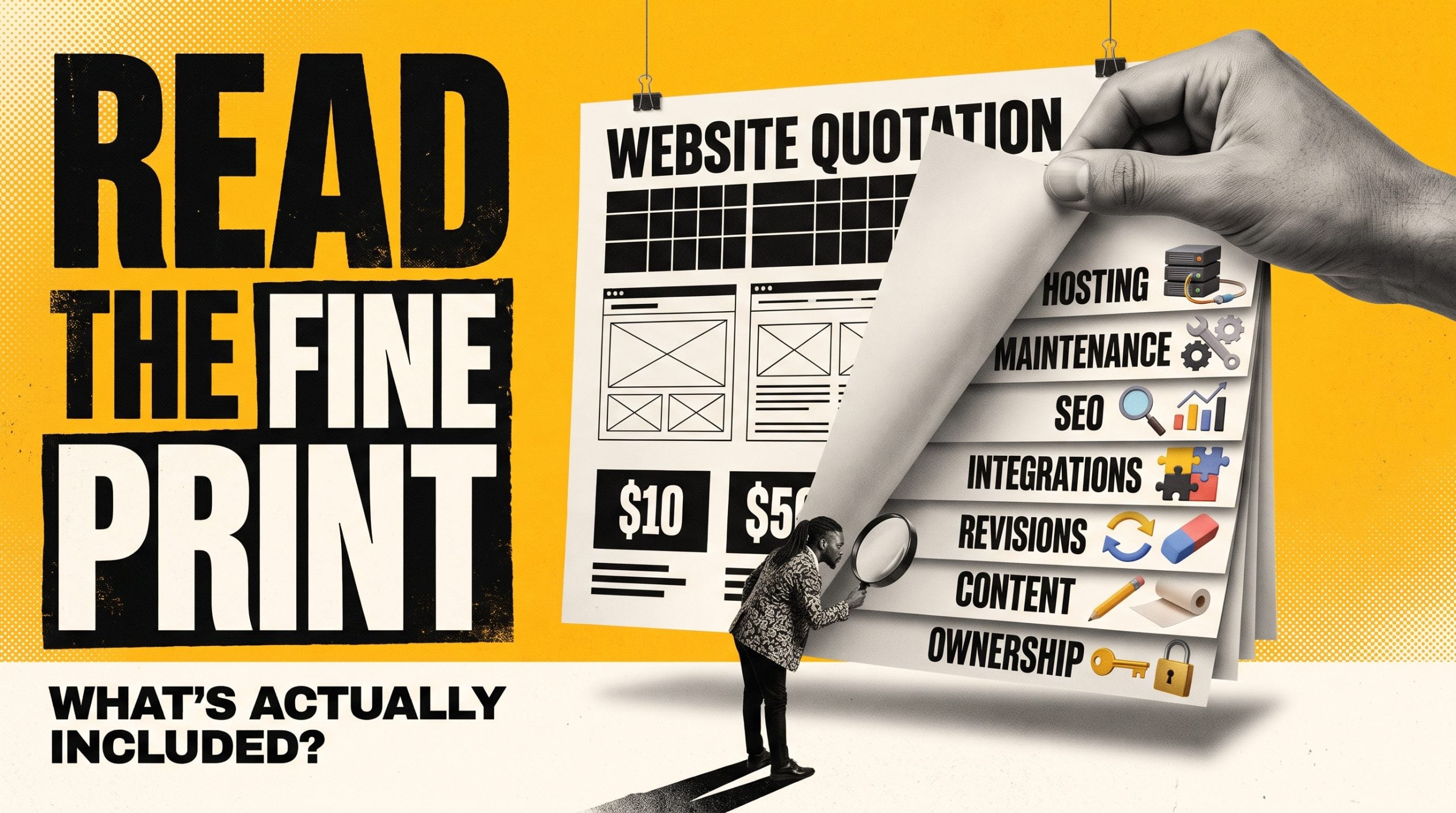
The most reliable way to compare quotes is to force them into the same shape. Copy this table, fill in a column for each supplier, and mark anything not mentioned as “unconfirmed” until the supplier answers in writing.
Scope item | Quote 1 | Quote 2 |
|---|---|---|
Number and type of page templates designed | ||
Custom design, adapted theme or template? | ||
Copywriting included? How many pages? | ||
Photography or stock images included? | ||
Content migration from the existing site? | ||
CMS and training included? | ||
Forms, bookings, payments or ecommerce | ||
Integrations (named systems) | ||
Redirects from old URLs | ||
Analytics and conversion tracking set up | ||
Basic on-page SEO (titles, descriptions, structure) | ||
Performance targets stated? | ||
Accessibility standard stated? | ||
Revision rounds included | ||
Hosting included? For how long? | ||
Post-launch support period | ||
Domain registered in your name? | ||
Who owns the design, code and content? | ||
Prices including or excluding VAT? | ||
Payment schedule and timeline |
Two quotes that look far apart often converge once this table is filled in. Sometimes the expensive one turns out to be the better buy. Occasionally the cheap one does everything you need.
Write acceptance criteria into the agreement
“A fast, mobile-friendly website” can’t be checked. Measurable criteria can. Consider asking that the final site be tested against:
Google’s Core Web Vitals thresholds: Largest Contentful Paint of 2.5 seconds or less, Interaction to Next Paint of 200 milliseconds or less, and Cumulative Layout Shift of 0.1 or less (Google Search Central). Google assesses good real-user performance at the 75th percentile where sufficient field data is available (web.dev). Agree what can be tested before launch using lab tools and how field performance will be monitored later.
An accessibility target, such as WCAG 2.2 Level AA for the main templates and forms. WCAG 2.2 is the current version of the W3C’s accessibility guidelines, and is also published as the international standard ISO/IEC 40500:2025 (W3C).
Functional checks: every form submits and is received, analytics records your key actions, and old URLs redirect correctly.
Handover: all logins, the domain and any licences transferred to you, with documentation.
Not every small business will contract for every test. Even a short, written acceptance checklist makes expectations clearer for both sides.
What happens after launch
Ask what support is included in the first weeks after launch, what counts as a bug (fixed free) versus a change (billed), and the hourly or fixed rate for changes afterwards. Making that distinction in writing reduces room for disagreement.
Red flags at both ends of the price range
Very cheap quotes aren’t always bad, and expensive ones aren’t always padded. These signs are worth questioning wherever they appear.
In low quotes:
The domain is registered in the supplier’s name
No mention of who supplies content
“SEO included” with no description of what that means
No backups, updates or security mentioned anywhere
Unlimited revisions, which often means no defined design process
In high quotes:
Large line items with vague names, such as “digital strategy” with no deliverable attached
Required long-term retainers bundled into the build price
A proprietary platform you can’t move away from, without that being stated plainly
Guaranteed search rankings. Nobody controls Google’s results, and Google says that crawling and indexing cannot be guaranteed, and submitting a sitemap does not guarantee rankings (Google Search Central).
At any price:
No written scope
Ownership terms that only appear in fine print, or not at all
Pressure to sign before you’ve seen what’s included
What should a South African small business budget?
Without knowing your business, any number is a guess. A more useful approach is to work out which kind of site you need, then compare quotes for that kind of site.
Your situation | What the site mainly needs to do | Where to spend | Where to save |
|---|---|---|---|
Local service business, most work by phone or WhatsApp | Prove you’re real, show services and area, make contact easy | Clear copy, mobile contact paths, Google Business Profile alignment | Custom design flourishes |
Professional firm competing on credibility | Build trust with considered buyers | Design quality, strong service pages, case studies | Complex features |
Business moving existing customers online | Bookings, quotes or portals | Functionality and integrations | Page count |
Online shop | Sell and fulfil orders reliably | Payments, product data, checkout, delivery rules | Decorative pages |
Business replacing an existing site with search traffic | Keep and grow visibility | Redirects, content migration, technical SEO | A redesign for its own sake |
Then budget for the first two years, not just the build. Add the recurring items from the ownership section, plus your own time for content and approvals.
Questions to ask before you sign

What exactly is included in this price, page by page and feature by feature?
Who writes the content, and what happens if mine is late?
How many revision rounds are included, and what does an extra round cost?
Is the domain registered in my business’s name?
What will I own when the project is paid for, and what can I take with me if I leave?
What recurring costs will I have after launch, and from when?
What performance and accessibility standards will the site be tested against?
How is analytics set up, and which actions will it track?
If I already have a site, how will you protect its existing search traffic?
What is a bug and what is a change after launch?
Are your prices quoted including or excluding VAT?
How does the site handle personal information collected through forms? Personal information collected through forms may be subject to South Africa’s Protection of Personal Information Act, depending on the processing context (Information Regulator: POPIA legal resources). This is not legal advice; ask who receives, stores and uses the information and what safeguards apply.
When a simple site is enough, and when custom work earns its cost
A simple site is enough when your customers already know what they want, find you through referrals or local search, and mainly need to confirm that you’re credible and how to reach you. In that case, clarity, speed and easy contact matter far more than bespoke design.
Custom work starts to pay for itself when the website itself has to do something your competitors’ sites don’t: explain a complex offer, qualify leads before they reach you, take bookings or payments, connect to your operations, or compete in search for valuable terms. At that point, elements of the project may need to be scoped like business software rather than a simple brochure website.
Magoven’s current once-off website packages include a Starter Website from R5,000 and a Business Website from R10,000. These are different service tiers, not interchangeable quotes for the same scope. Magoven is not VAT-registered and does not charge VAT on these prices. Ask for a written breakdown of the relevant package, any extras and the recurring charges before deciding.
Magoven also offers a monthly website arrangement. Under that arrangement, the website remains Magoven’s property; paying the monthly service fee does not transfer ownership. Ask for the applicable service agreement to understand the subscription, cancellation process and treatment of your domain, content and data.
Either way, the best quote is the one you can fully read. Explore Magoven’s web design services and ask for a written scope covering deliverables, recurring costs and handover terms before committing.
Frequently asked questions
Is a monthly website plan cheaper than a once-off build?
A monthly plan can reduce the amount you pay before launch, but it is not necessarily cheaper over the full life of the website. Compare total payments over 24 months, the support included and the cancellation terms. With Magoven’s monthly website service, the website remains Magoven’s property, so customers should not assume that they can transfer the complete website to another provider if the service ends.
Do South African website quotes include VAT?
Do not assume the price includes VAT. Ask each supplier whether the quote includes VAT and whether the supplier is VAT-registered. SARS states that VAT is levied on applicable supplies by registered vendors (SARS VAT guidance). Compare the total amount payable, not just the headline price. Magoven is not VAT-registered and does not add VAT to its advertised R5,000 Starter and R10,000 Business website prices.
Does a website come with SEO?
Some quotes include basic on-page setup, but “SEO included” can mean anything from page titles to an ongoing campaign. A new website gives search engines something well-structured to index. It doesn’t, on its own, guarantee rankings or traffic.